

The Scientific Foundations of Empowered Parenting

Empowered Parenting is so much more than just a nice idea. It’s a parenting methodology that is rooted in evidence-based developmental science, psychology, and emotional intelligence.
These are the skills that parents can foster to be able to maintain a trust-based, warm, and connected relationship with their children while providing the mentorship, guidance, and support they need to grow into thriving adults.
Parents are waking up to a really important truth: Parenting is the most important “job” we have, but it’s the one job for which there’s not enough education, preparation, and skills building!
We used to think that parenting should come “naturally,” but what truly comes naturally is deeply connected to the way we were parented.
So, whether we are reactively trying to parent differently than we were parented (perhaps making us feel anxious about being the perfect parent or being too permissive because we were parented harshly) or we are unconsciously and unintentionally perpetuating the same cycles of emotional wounding or harm on our kids that were done to us…
Learning to be a more empowered parent while still parenting well can bring so much more peace of mind, connection, fulfillment, and enjoyment to our roles as parents.
Empowered parenting creates a nurturing and secure environment for children to grow and develop into happy and healthy individuals. It is based on the idea that parents can raise their children without punishment, fear, or coercion and promote mutual respect, cooperation, and communication.
The core principles or pillars that make up this way of parenting are deeply rooted in science.
At the Jai Institute for Parenting, we have created a framework that has been used thousands upon thousands of times. It’s a path that gives parents the information they need to understand behavior (their own and their children’s) at a whole new level. With this understanding, parents are supported in developing their approach to benefit the entire family.
Jai’s empowered parenting method is rooted in five foundational pillars. We believe this is the manual parents have waited for, but reading it alone doesn't change everything. People need practice and support to apply it, embody it, and become it. This disconnect is why parental coaching support is vital.
Our
parent coach certification program focuses on these five pillars of empowered parenting.
Pillar 1: Empowered Communication
The first pillar of empowered parenting is based on the work of Dr. Marshall Rosenberg and non-violent communication. His book on non-violent communication is part of our curriculum because communication is the root of the health of all human relationships.
When we can clearly communicate, in what Dr. Rosenberg calls the language of feelings and needs, with the people we love, we also model how they can communicate their feelings and needs in a nonviolent framework. From this place, relationships can truly flourish.
As defined by Rosenberg, violence harms the physical, emotional, or relational experience of another human being. This definition is life-changing.
Our mission here at Jai is to allow children a nonviolent childhood experience.
This pillar centers around:
- Observing your child's behavior without labeling it as good or bad
- Communicating your feelings to your child using "I" statements
- Determining what needs are driving your feelings
- Making requests that are clear, specific, and positive
- Practicing active listening and seeking to understand your child's perspective
At Jai, we refer to this approach as
empowered communication. We teach a 10-part communication framework that our parent coaches teach their clients so they can talk to their children in a way that their children can hear and listen to their children and in a way that lets them know they are heard.
Pillar 2: Emotional Intelligence
Emotional Intelligence (EQ) is the ability to experience the entire spectrum of human emotions, understand their nuance, and feel and express them without causing harm to ourselves or others. For example, to know the difference between rage and frustration versus saying, “I'm angry.”
Emotional intelligence is a more significant indicator of life fulfillment than IQ. As parents, we can model emotional intelligence to our children by understanding our emotions and helping them regulate theirs.
How do children learn how to feel their emotions?
How do they learn how to be angry?
How do they learn how to be sad?
How do they learn to grieve?
How do they learn to handle disappointment, rejection, or failure?
From the way that we as parents model it.
Teaching emotional intelligence to children can help them develop skills to manage their emotions, build positive relationships, and navigate social situations effectively throughout their lives.
Some strategies we can use to teach EQ to our children can include:
- Modeling emotional intelligence: Children learn by observing our behavior. Show your children how to identify and express emotions in a healthy way when you interact with them, model empathy, active listening, and problem-solving skills.
- Teaching them an emotional vocabulary: You can help children develop a language of emotions by naming the feelings you experience and helping them to identify and name theirs. You can use visual aids like a chart or a wheel to help children identify and express their emotions.
- Practicing empathy: Encourage children to put themselves in someone else's shoes and imagine how they might feel in a particular situation. We can do this by practicing empathy directly with them. Taking our children’s feelings and needs to heart and showing them that we empathize with them is an excellent way for them to see what that feels like.
- Practicing active listening: Teach children by modeling active listening in conversations with them. Ask questions, clarify information, and reflect on what you've heard.
The best way for us to teach is to learn first and then support our children. An interaction focusing on helping children develop their EQ might sound like, ‘Oh, I can see anger in your body. What does that feel like? Do you think you're more frustrated, or are you more sad?’ In age-appropriate ways, we can start to communicate in this language.
Pillar 3: Nervous System Regulation
Understanding how our nervous system reacts to external stimuli and how we can self-regulate and remain calm, even in stressful situations, is a foundational element in empowered parenting. By learning to regulate our nervous system, we can provide co-regulation for our children, who cannot yet control their nervous systems.
Let’s say a stimulus comes in (imagine a two-year-old having a tantrum), which brings up a lot of escalation in our nervous system. We might start to feel tightness in our chests or heat in our faces. Maybe we will begin to sweat a little bit. Our fight, flight, or freeze response gets activated. We will do anything to stay safe when our nervous system is in a heightened state.
In a situation like this, our body acts as if without conscious thought, without being aware of it, as if we are in danger. And when we're in danger, we react. If there were a tiger in the room, this would be a very good thing. But for most parents, there is not actually a tiger in the room. There's a two-year-old having a tantrum.
Our brain is slower than our nervous system. Our nervous system reacts in less than a nanosecond. The stimulus comes in, and the nervous system assesses, “Is this dangerous?” If it perceives danger, we react. The brain kicks in and always creates a narrative supporting the reaction.
This one awareness alone will change your life: stimulus, reaction, justification.
Finding ways to get grounded in our bodies in these moments is a great place to start changing our behavior patterns. At the Jai Institute, we use an ANCHOR framework to guide us through moments where we need emotional self-regulation to show up for ourselves and our children when our nervous systems are triggered.
Anchor stands for:
- Awareness of your body
- Name what is happening in your body
- Connect to your sensory calming tool
- Honor the process
- Open to connection
- Recommit to your child & the present moment
Pillar 4: Child Development & Mindsight
Not being aware of our child’s brain development creates an incongruence in our parenting. We expect our child to be able to deliver behaviors that are impossible for their development.
Lacking information on how children’s brains develop and what they require to thrive leaves missed opportunities for crucial developmental phases. Our empathy, our secure attachment within ourselves and with our children, and our holding safe space are what GROWS our children’s brains. Fear and stress inhibit growth and delay the development of the child's emotional regulatory centers and prefrontal cortex.
Child development includes ages and stages of development, the science of brain development, and knowledge of universal human needs and the feelings that arise from those needs.
Understanding the human brain is a complex task. There has been an explosion of information about the brain in recent years. There is so much to know.
In Jai’s parenting model, the goal is not to present all the complexities of the growing brain or to describe the multitude of its different regions. Our goal is to help parents learn a few basic facts about child development that will help them as they expand their awareness of empowered parenting. We want them to have some simple knowledge about the way that their brains function, as well as to understand their children’s brains so they can have realistic age-appropriate expectations.
“Mindsight” is a term unearthed by Daniel Siegel describing one’s ability to “see inside their own mind, and the mind of another, with curiosity, openness, acceptance, and love.”
It is a parent’s ability to know their child so intimately that rather than seeing their behavior, they become curious and connected to their underlying need.
Understanding childhood development is essential to our ability to see a child’s perspectives, perceptions, and behavior through their current level of cognitive ability.
Here’s an example:
Let’s imagine a teenager becoming incredibly frustrated. They had a full day at school, followed by a long basketball practice. We ask them to unload the dishwasher, and they erupt.
They storm out of the room and slam their bedroom door.
Cognitively, we know that teenage brains are going through a huge developmental shift called pruning.
Using mindsight, we can imagine the stresses that this child is under.
If we address the behavior (not doing the dishes and slamming the door), we miss the need.
The need: Better stress management strategies.
How can we support them to process their stress, verbally and physically, more effectively?
And how might we show up for them so that they can learn what to do instead of being admonished for what they shouldn’t?
This is the crux of Empowered Parenting. It’s about building kids up and allowing grit, resilience, and independence to develop over time.
All behavior is an expression of a need and whether that need has been met or unmet.
Mindsight is our willingness to see beneath the behavior and truly get curious about what is happening within our child’s thoughts and perceptions that are creating the behavior.
When our children feel SEEN by us and understood without judgment or fear, their brains grow. Feeling seen is a prerequisite for feeling safe. We develop, integrate, grow, and thrive when we feel safe.
Without mindsight, an interaction might sound like this: “Hey! What’s wrong with you? Why would you do that?!”
In the same situation, while applying mindsight tools, one may sound like this: “Hey, love – I saw you grab your sister’s work out of her hands. Help me understand what's going on for you. I’m curious about what you were thinking and trying to do.”
Mindsight allows us to partner with our children before they have the language of feelings and needs
to co-create solutions so that all needs in the family can be met.
Our brains and children's brains have something called mirror neurons. Mirror neurons are brilliant, almost psychic. They pick up information from countless different sources and distill it through a lens of perceptions, beliefs, experiences, fears, and expectations to create a narrative.
As parents become mindsight experts, we can allow our children the gift of having a clearer and clearer lens.
So, how do you begin to cultivate mindsight?
1. The first strategy to having mindsight is to open up to the possibility that your child’s experience of what’s happening differs from yours.
2. Mindsight isn’t about assumptions; it’s about curiosity. It’s learning to ask your child, in age-appropriate ways, what is happening for them in their bodies and minds.
3. We teach something at Jai called asking an ‘empathy guess.’ This guess can sound like, ‘I’m wondering if what you’re feeling is angry?’ Then the other person may say, ‘Yes, that’s it,’ or they may clarify.
Using our understanding of the brain, we can learn, model, and cultivate compassion and empathy. By doing this, we’re helping our children learn that sharing their innermost truths is safe.
Pillar 5: Attachment Science
Attachment refers to the safety and security we feel in relationships with ourselves and others. Attachment science studies attachment styles and their impact on how we move through the world in relationships.
Creating a secure environment for children is about laying a foundation for them to feel safe in their relationships with themselves and others. By cultivating a secure attachment, we can give our children a foundation of safety and security to grow and develop into happy and healthy individuals.
Dr. Tina Payne Bryson and Dr. Daniel Siegel, leading experts in attachment science, have called us all forward to make secure attachment the goal for parents.
Attachment science shows us that when parents consistently respond to their children's needs, it helps them develop a sense of security and trust. Children with secure attachments will likely have better emotional regulation, self-esteem, and social skills.
Attachment is formed through interactions with caregivers. Attachment formation is not just about physical needs like food and shelter but also emotional needs like comfort and attention. Consistent and sensitive responses from a caregiver help children feel secure, and this sense of security forms the foundation of attachment.
An attachment disruption, such as a parent being absent, violent, or unresponsive, can negatively affect the child's development. However, attachment can be repaired through positive interactions and consistent responses from a caregiver. This example highlights the importance of an ongoing commitment to continue working on how we can be responsive and attentive to our child's emotional needs throughout their lives.
Creating secure attachments for our children is the goal. To do that, we have to create it within ourselves first. Most of us are harder on ourselves and more judgmental of ourselves than anyone else in the world.
The Five Pillars of Jai’s Empowered Parenting Methodology
- Empowered Communication
- Emotional Intelligence
- Nervous System Science
- Child Development & Mindsight
- Attachment Science
These five pillars are the core of Jai’s Empowered Parenting Method. We believe that while you can read books on these topics,
coaching allows this to move from information to transformation.
We teach our
parenting coach students a wide array of coaching tools, including relational coaching, communication coaching, generational pattern coaching, and creativity coaching. Jai coaches apply our five pillars of empowered parenting through a proven parent coaching model, helping families to create a nurturing and secure environment for children to grow and develop.
By focusing on the five pillars of empowered parenting, we can build healthy relationships with our children based on empathy, respect, and understanding. It is never too late to start transforming your parenting, and with practice, support, and accountability, we can create a safe and loving home for our children to thrive in.
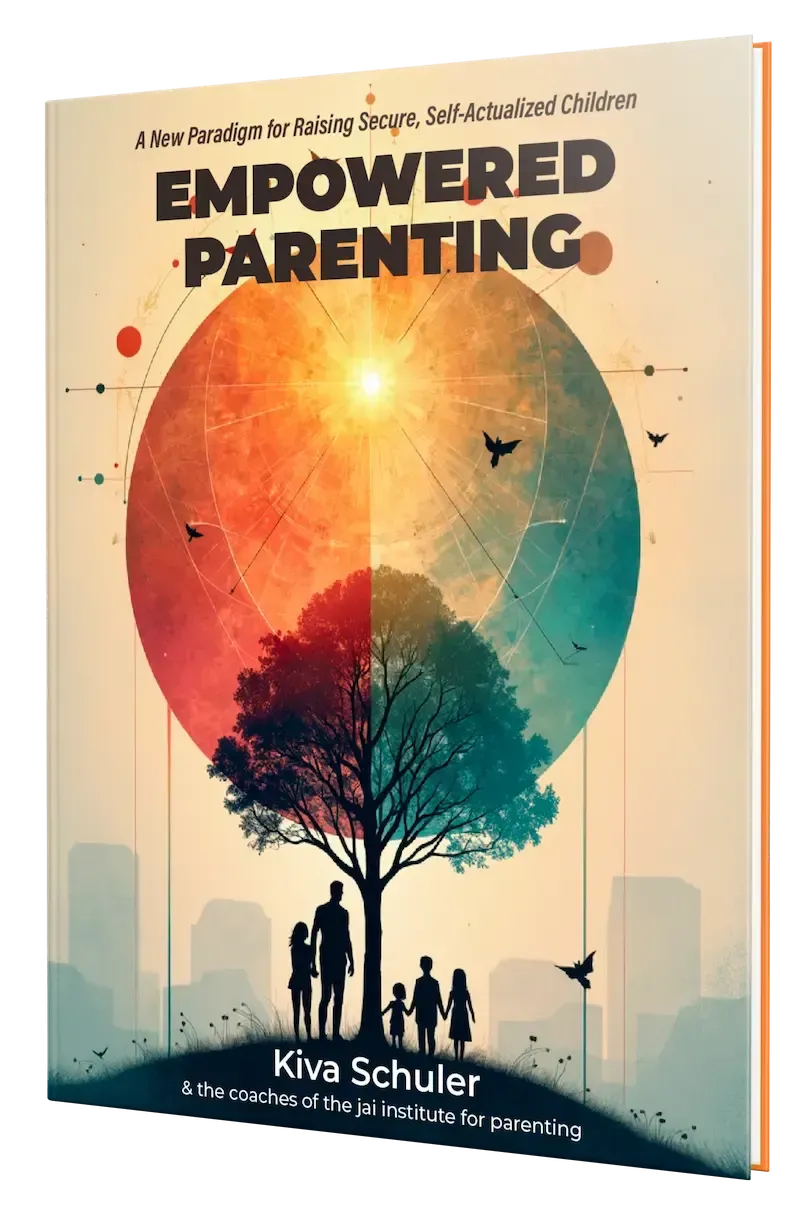
Empowered Parenting
Raise Resilient Children Without Power Struggles
In this FREE ebook, we explore how you can:
- Navigate your child's big emotions without caving in or resorting to reactivity
- Techniques to set
effective boundaries and limits that stick… Peacefully!
- Ways to
foster true self-reliance in your children







Share This Article:

Curious for more?

Jai Parent Coach Certification
PROGRAM DETAILS >>
Free Resource Center
FREE RESOURCES >>